Program Overview
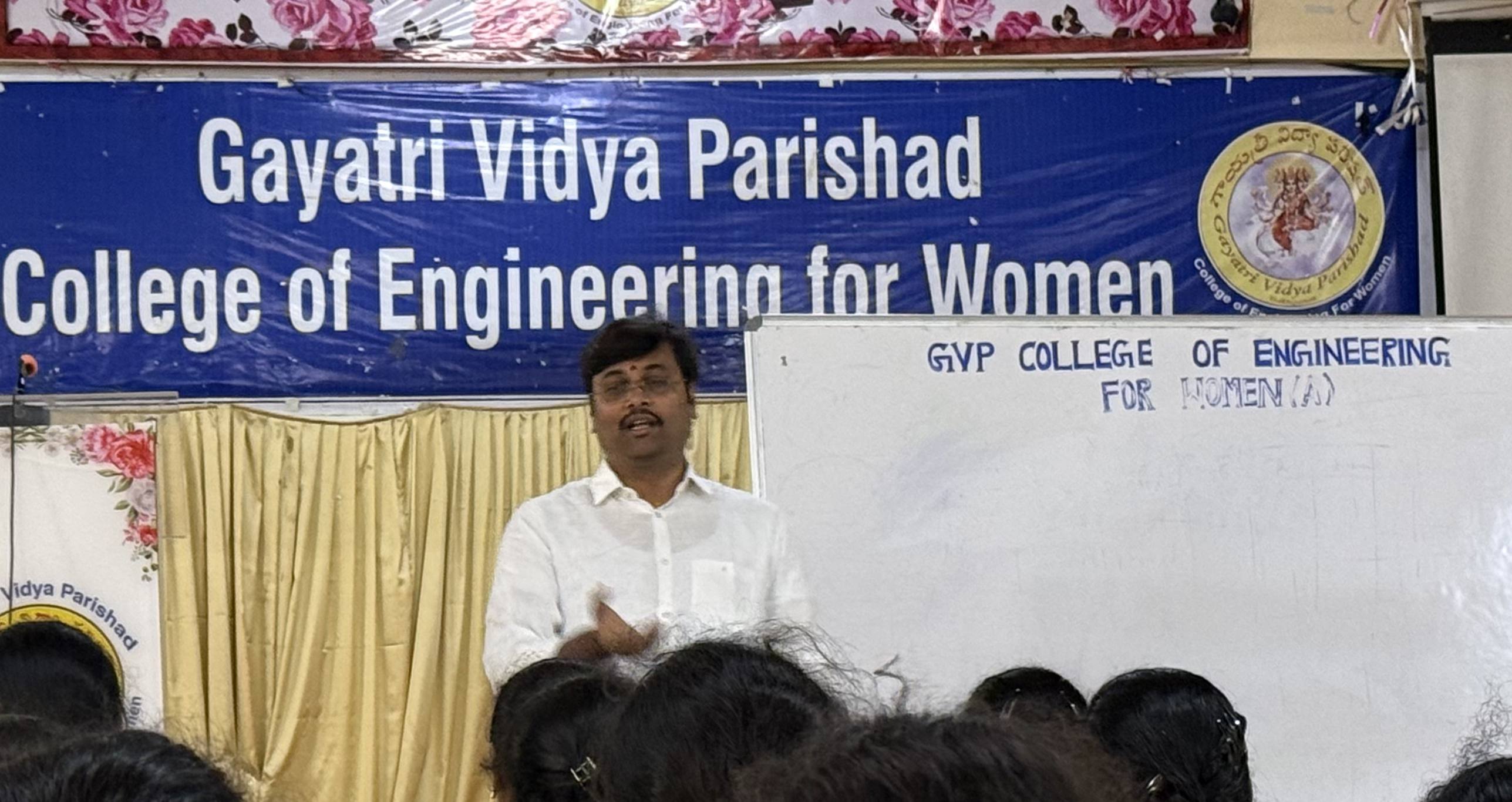
A five-day hands-on session at Gayatri Vidya Parishad College of Engineering for Women focused on learning the fundamentals of Data Structures and Algorithms. Students were introduced to core concepts and practiced writing programs to develop algorithmic thinking from the ground up.
Visual Reference For DSA Concepts
Session 1
Data Structures — Arrays & Linked Lists
A visual walkthrough of arrays and linked lists — memory layout, operations, and comparisons with interactive diagrams.
→
Session 2
Trees — A Visual Introduction
Explore directory trees, DOM trees, and expression trees with annotated visual examples to build intuition around hierarchical data.
→
Session 3
Recursion, Divide & Conquer, Binary Trees
Visualise how recursion unwinds, how divide & conquer splits problems, and how binary trees are built and traversed step by step.
→
Session 4
Trees, Binary Trees & BSTs
An interactive guide to general trees, binary trees, and binary search trees — with hands-on insert & search on a live BST.
→
Session 5
Anatomy of a Tree
A visual terminology guide to the parts of a tree — root, nodes, edges, leaves, subtrees, depth, and height, all annotated on live diagrams.
→
Session 6
The Composition of Code
A step-by-step journey from variables and expressions all the way up to modules and packages — how small pieces build whole programs.
→
Session 7
Binary Tree in C — Build & Count
Build a binary tree in C and count its nodes with a live visualisation of the recursion call stack as it unwinds frame by frame.
→
Session 8
Call Stack Walkthrough
Step through
avg_numbers(6, 10) instruction by instruction — watch the program counter, code memory, and call stack grow and shrink.→
Session 9
The Art of Recursion — Practice Worksheet
Read each program carefully, trace through it line by line on paper, and write what you believe the program will print in the box provided.
→
Session 10
The Art of Recursion — Practice Worksheet II
A second helping. New patterns, new traps. Read each program carefully and write what you believe it will print.
→
Session 11
The Code-Tracing Tutor — A Prompt
A reusable system prompt that turns any capable LLM into an interactive code-tracing tutor — show code, predict output, probe execution state, adapt difficulty.
→
Session 12
Caching — The Art of Not Asking Twice
A tour of five layers where caching lives — from CPU silicon to browser, DNS, and database — and why each one is worth the trouble.
→
Session 13
Why Machines Prefer Postfix
Move the operator to the end and arithmetic precedence dissolves into a single linear scan. One stack, three rules, no parentheses — the model behind today's virtual machines.
→
Session 14
System Internals
Master the fundamentals of computing — interactive Figma slides paired with a full video lecture on how systems work from the inside out.
→
Session 15
Linked Lists
Visualise node insertion, trace pointer patterns through sample C code, and test your understanding with five hand-tracing practice questions.
→
Session 16
Quiz Me — C Data Structures
A pair of LLM prompts for students who have just finished reading about a data structure in C — and want to find out, gently, whether they actually got it.
→
Session 17
Dynamic Programming, Visualized
Dynamic programming is what you do when a recursion repeats itself. Solve each subproblem once, write the answer down, and look it up next time — a handful of ideas, two examples, many drawings.
→
Session 18
Read the Shape of the Problem
A reusable prompt that turns any capable LLM into a senior systems-design interviewer — students get plain-English problems and must recognise, from the verbs alone, which data structure fits.
→
Session 19
Time Complexity & the Art of Counting Steps
A graduated set of seventeen short programs across four difficulty levels — determine the worst-case time complexity in Big-O notation for each.
→
Session 20
Call Stack — Demo
Watch the call stack grow and unwind in real time — a terminal recording that shows every push and pop as functions call and return.
→
Session 21
Quiz Me — Linked Lists & BSTs in C
Two prompts that turn any capable LLM into a Socratic quiz partner — one concept at a time, hints by analogy, no spoilers, five correct answers to earn a summary.
→
Session 22
Count the Work, Not the Lines
A reusable prompt that turns any capable LLM into an algorithms interviewer. Five code samples ramping from a single loop to a recursive function — the interviewer never gives the answer, only counting questions.
→
Session 23
The Pointer, Visually
A visual walkthrough of pointers in C — what a pointer actually is, how dereferencing works, and the mental model that makes the syntax feel obvious.
→
Session 24
Pointers vs Arrays — When Each Earns Its Place
Pointers and arrays look interchangeable until they aren't. A side-by-side tour of where they secretly differ — and when to reach for which.
→
Thank You — Gayatri Vidya Parishad College of Engineering for Women
We thank the faculty and management of Gayatri Vidya Parishad College of Engineering for Women, Visakhapatnam for the warm welcome and for providing the opportunity to engage with their students. The enthusiasm of the students made every minute worthwhile.